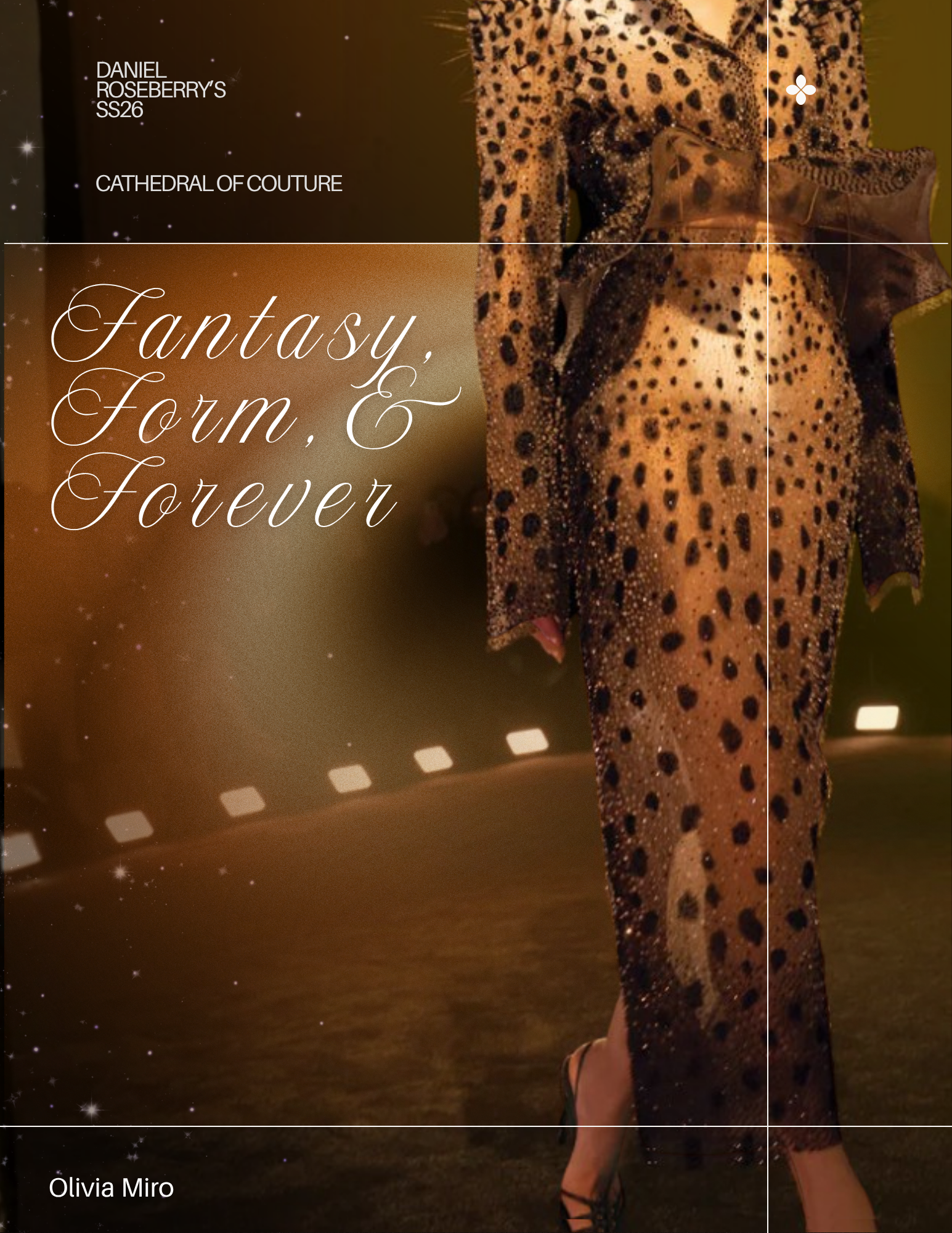
Cathedral of Couture: Fantasy, Form, and Forever in Daniel Roseberry’s SS26
April 13th, 2026
Olivia Miro
Graphics by Adelaide Feeley
About a month ago, it was Paris Fashion Week, and the entire fashion-loving community was twiddling their thumbs, stalking the schedule, and, if they were lucky, buying a ticket to travel to France to experience the best haute couture has to offer. This one week has the power to define the designer and the brand's intentions for the upcoming season, leaving their months or years of hard work at the mercy of the fashion and social media community. An incredible collection can not only lead to good publicity and high sales but also shift the industry's framework indefinitely. That is what I believe Daniel Roseberry accomplished in his past show, and it is increasingly important to translate timeless art like this into words.
Beginning with the visionary herself, Elsa Schiaparelli, who walked so that talents such as Daniel could run, she redefined this house and fashion as not just functional but also artistic. She was not just a designer, but a pioneer with the first piece she crafted, a trompe-l'oeil motif (optical illusion) on a hand-knit sweater, catching international attention for its singularity and helping launch the fashion house. Then came the creation of the ‘Mad Cap’, which helped mark Elsa’s early career not only with recognition but also with unique creativity. Collaborating with generational talents like Salvador Dali and even dressing royalty, she looked beyond the confines of simply creating wearable pieces, but relied on timeless artistry that makes a statement.
From Christian Lacroix to Bertrand Guyon, Schiaparelli has seen many talents; none has translated that legacy into a modern language of monumentality quite like Daniel Roseberry. A Texas native and son of a priest and artist, he was known to have been raised in an incredibly religious family. He even described his early childhood as “one of searching and belonging,” where he was “daydreaming all the time of the things we couldn’t have.” As a closeted gay man growing up in the South, he described feeling confined by the religious expectations of his family and community until he finally accepted the invitation to FIT.
Since then, Daniel has created such a distinct vision of elevated whimsicality for this major fashion house in such a saturated market, while still leaving room for endless creativity. Dressing some of the biggest talents and consistently earning the praise of industry professionals, he continues to push boundaries that rightfully earn this recognition. However, none stood out quite like his SS2026 collection, titled “The Agony and Ecstasy,” a body of work that feels deeply personal but also one that translates timelessly in its impact.
This show was inspired by an impromptu visit to the Sistine Chapel and Michelangelo's 1508 work, but is rooted in a deeply magical, futuristic imagination of emotion, with distinct nods to Elsa's early creations. Grounding this collection’s “emotional heartbeat” in the perspective of the pieces being crafted not for “what (they) look like, but how (they) feel when (they) make it?” He clearly showed the fashion and art world how Schiaparelli's history and future combined to form a compelling story. His intentional mix of abstract creation, rooted in the historical work of generational talents, is what sets this collection apart and, I believe, will cement his work in magazines and history books forever.
He accomplished this through many intricate and distinct design techniques. The anatomical silhouettes of these pieces, which he has used in previous collections, show features molded to the models' forms, as if crafted directly on their bodies. With a high neck and a low, scooped back, these creations, often adorned with lavish animal fabrics or magical patterns, produced a distinct archaeological effect. They felt almost as if they were artifacts from another civilization, one grounded in historical shapes like the corset, but also a futuristic realm where animals were one with humans. This collection showcases Daniels' design diversity, connecting generations of fashion and history into an imaginative future that feels so distinctly tied to the brand and his time there.
It is precisely that aspect that sets this collection apart. While Daniel previously defined Schiaparelli through his use of human body parts, he creatively built on this trademark by combining these traditional elements with bird heads, scorpion tails, and sharp stingers. This made the collection feel completely untethered from time, taking the viewer to a world that lives quietly outside of reality. Two paired pieces, elegantly resembling scorpions, even took on their own identity, Roseberry naming them the “Scorpio Sisters,” which, personally, stand as two of my favorite designs in the collection.
Watching this collection for the first time, I was transported. From seeing my friends' eyes widen or hearing the gasps of a sort of simultaneous horror and enthrallment, I was obsessed, thinking about each look for days after. It wasn't just a collection that provided 15 minutes of entertainment of admiring clothes I know I would never own, but one that made such a bold statement that the feeling it produced didn't fade after the runway. As I began to deep-dive into the message and work behind this collection, watching the show over and over again, I realized that Daniel was providing the viewer with a masterclass in seamlessly blending art and couture-level discipline, creating the perfect recipe for a timeless show.
In the end, not only did Daniel give us a revolutionary collection, but one that shows the importance of balancing consistency and innovation within a rich, layered fashion house like this. When creating new collections each season, he shows how to make a lasting impact with a diverse and layered show while grounding it in a consistent design and identity. That is truly the hardest balance to strike in haute couture, and it is one that can often come at the expense of pure artistry. There are so many designers out there making the same courageous choices as Rosbery, and it is our job as fashion lovers to remember and carry on their legacy to keep this industry interesting.
His work is undeniably captivating, but what makes it truly resonate is how it embodies the essence of this edition, an exploration of fashion as something immortal rather than grounded in a single season or fashion week. In The Agony and Ecstasy, Roseberry creates pieces that transcend trend cycles, through the anatomical silhouettes, surreal embellishments, and mythological forms feel less like garments and more like artifacts, objects that could exist across time rather than within a single collection. It is this balance between past, present, and fantasy that makes his work timeless, positioning each piece not just as couture but as enduring art.
“…a lasting impact with a diverse and layered show while grounding it in a consistent design and identity.”