Borrowed for the Runway, Banned in Real Life
November 10th, 2026
Aidan Lane
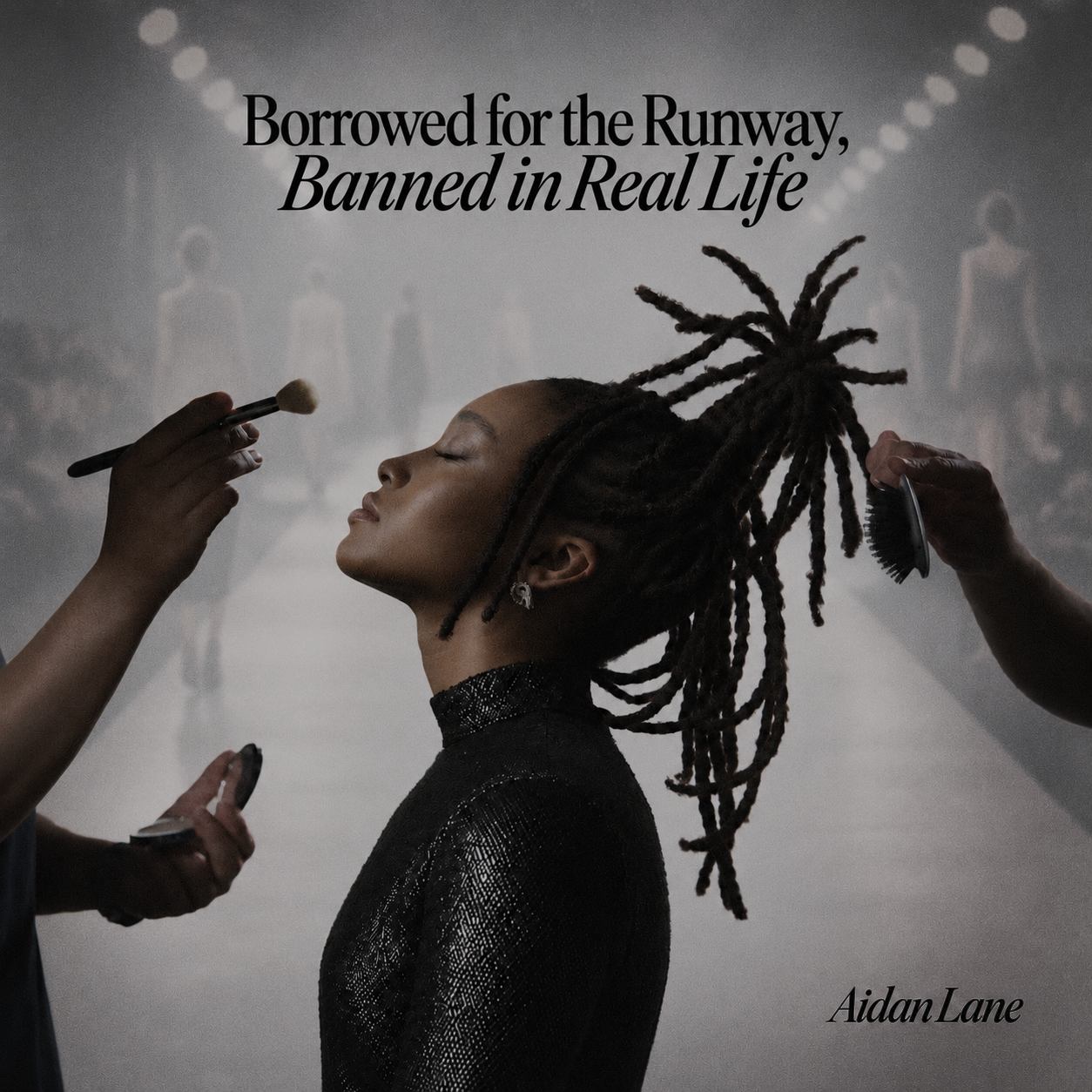
Graphics by Eve Mellis
On September 15, 2016, Marc Jacobs sent models down the runway for his Spring/Summer 2017 collection wearing towering arrangements of candy-colored wool locs. That same day, a federal appeals court upheld the dismissal of a discrimination lawsuit brought on behalf of a Black woman whose job offer had been withdrawn because she refused to cut hers. In one setting, locs completed a designer’s vision. In another, they apparently interfered with a company’s.
The coincidence seems almost too stark: fashion celebrating a hairstyle while an employer penalized the person wearing it. Jacobs’ models wore elaborate, temporary creations; Chastity Jones wore her own hair. What connected them wasn't an identical look, but the radically different judgments attached to locs—and the authority of the people making them.
The question was bigger than whether locs belonged on a runway. Why did they need a designer’s permission to belong anywhere else?
An Extensive List of Inspirations
Backstage, hairstylist Guido Palau described a look inspired by filmmaker Lana Wachowski, rave culture, acid house, and Harajuku girls. Palau sourced the wool pieces from Jena Counts, a Florida-based maker he found online. What was conspicuously absent from the explanation was an acknowledgment of locs’ deep association with Black culture.
That omission did not make every reference false. Wachowski could genuinely have inspired the look. Rave culture could genuinely have shaped its colors and proportions. But identifying the most immediate reference does not necessarily account for the history beneath it.
The backlash centered partly on that missing context, especially because the look appeared on a predominantly white cast. Critics questioned whether this was appreciation or another instance of fashion borrowing a culturally significant style while distancing it from the people most associated with it.
Palau’s own explanation captured that transformation. Speaking to T Magazine, he described Jacobs’ ability to take something “raw and street-inspired” and present it in a “more refined, fashionable manner.” Intended as praise, the language also revealed the hierarchy at work: the street supplies the material; the runway supplies the refinement.
Who, exactly, gets to decide when something has been improved?
Fashion’s talent for reinterpretation is also the heart of its business model. A familiar silhouette, an underground music scene, or an everyday styling choice can become desirable through a new context. But when the context receives more recognition than the community, reinvention starts to resemble selective memory.
Professional, According to Whom?
Six years before Jacobs’ show, Chastity Jones applied for a customer-service position at Catastrophe Management Solutions in Mobile, Alabama. According to the allegations recounted in the court’s opinion, she arrived for her interview in a blue business suit with her hair in short locs. She was initially told she had been hired, subject to completing tests and paperwork. Only afterward did her appearance become an issue.
Jones’ actual appearance had become secondary to an assumption about the style. She had passed the interview process, but a generalized judgment about locs outweighed what the manager saw.
The company’s grooming policy required employees to project a “professional and businesslike image” and prohibited “excessive hairstyles or unusual colors.” Its language did not explicitly mention race. Yet the dispute exposed how much interpretation can hide behind the word "professional."
The Equal Employment Opportunity Commission sued on Jones’ behalf under Title VII of the Civil Rights Act of 1964. On September 15, 2016, the Eleventh Circuit affirmed the dismissal. Under its precedent, the court distinguished between immutable racial characteristics—traits a person cannot change—and cultural practices or grooming choices. It did not treat locs as an immutable racial characteristic.
Placed beside Jacobs’ runway, the gap becomes difficult to ignore.
Credit Is Only the Beginning
Jacobs’ initial response made the controversy harder to separate from the collection. “I don’t see color or race—I see people,” he wrote in an Instagram comment Vogue reported. He later apologized “for the lack of sensitivity unintentionally expressed by my brevity” and clarified that he did see color but did not discriminate.
Not seeing race does little to explain why a hairstyle can produce admiration for one wearer and suspicion for another. Nor does a designer’s freedom to experiment guarantee that everyone whose culture informs the experiment enjoys the same freedom outside the show.
Acknowledgment matters because it makes influence visible. But credit alone cannot resolve the contradiction at the center of this show. Naming Black culture backstage would not have restored Jones’ job offer. Casting more Black models alone would not have changed an employer’s grooming standards. Those choices could improve the creative process without undoing the inequalities surrounding it.
In 2019, California became the first state to enact the CROWN Act, part of a legislative effort to extend protection against race-based hair discrimination to hair texture and protective styles, including locs, braids, and twists. That development addressed what runway visibility could not: the need for enforceable protections, not cultural approval alone.
Fashion likes to imagine that yesterday’s offense becomes tomorrow’s trend. Sometimes, though, the offense never disappears. It simply becomes fashionable on someone else.
Putting Jacobs’ show on trial does not require a verdict against inspiration. It requires looking beyond the runway to see who still follows the rules the runway congratulates itself for breaking. The real provocation was not a head full of pink and purple wool. It was the distance between being celebrated for borrowing a look and being penalized for living in it.
“Sometimes, though, the offense never disappears. It simply becomes fashionable on someone else.”
More from this edition
Featured