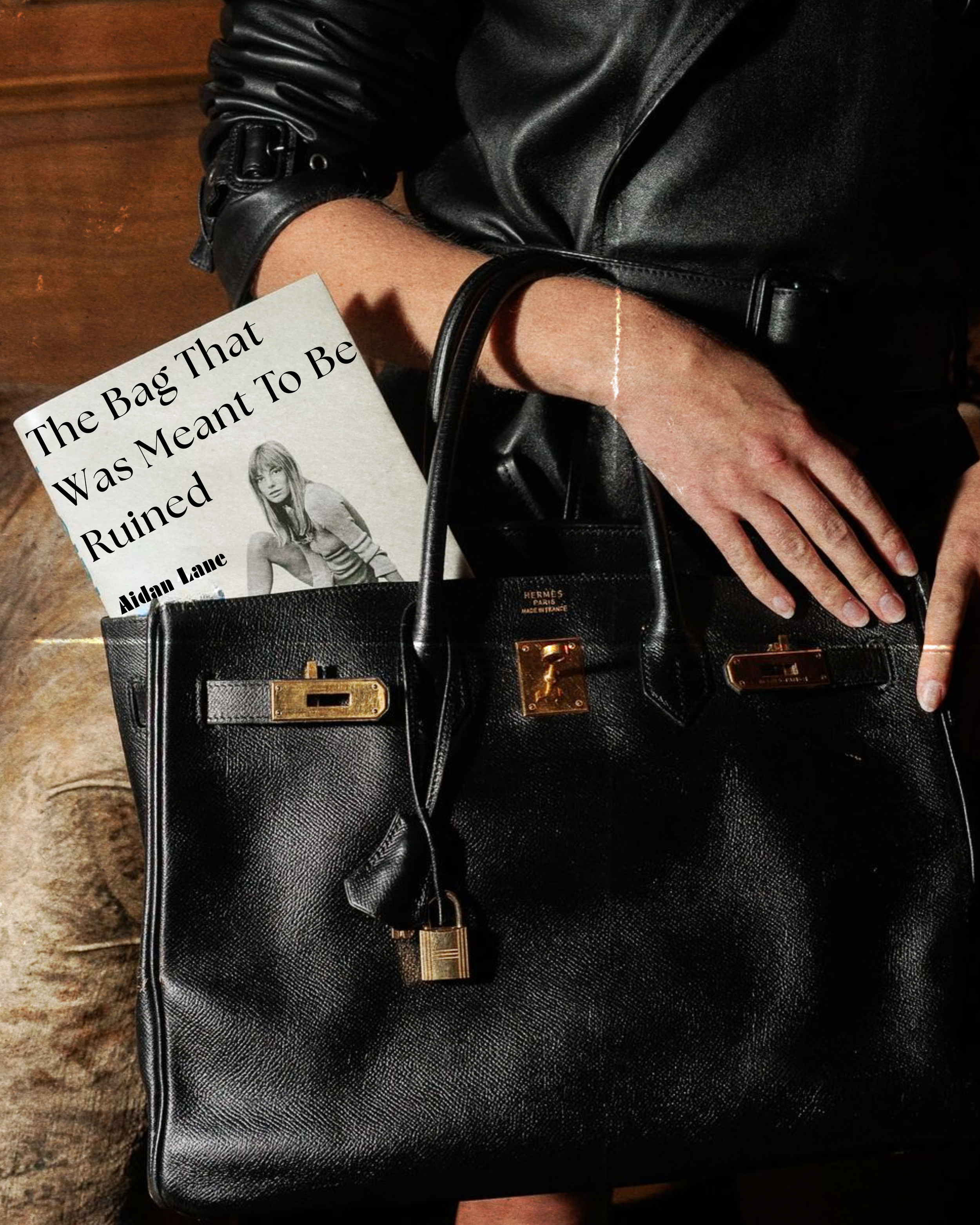
The Bag That Was Meant to be Ruined
April 27th, 2026
Aidan Lane
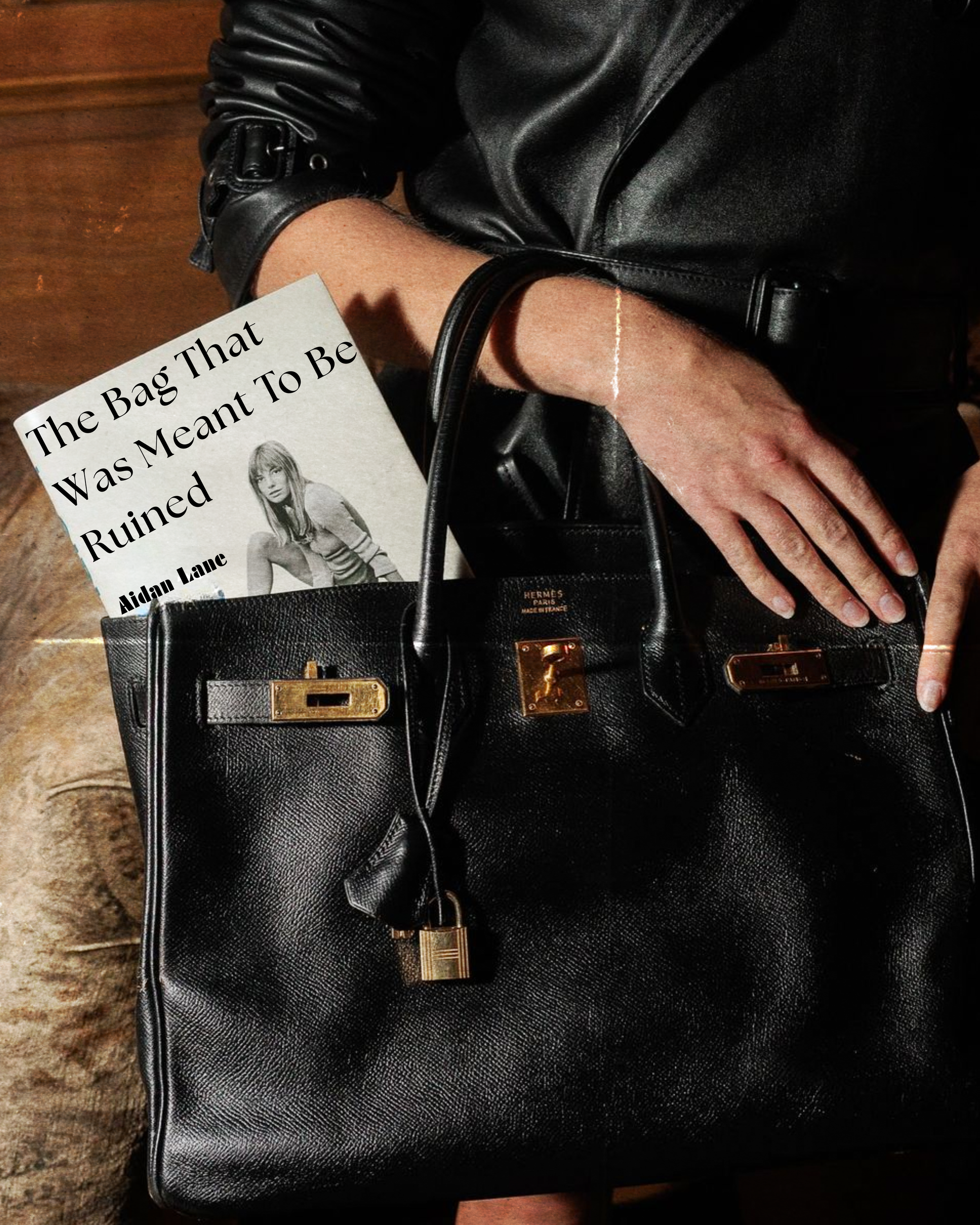
Graphics by Sarah Pomfrey
In the early 1980s, Jane Birkin sat on an Air France flight with Hermès chief executive Jean‑Louis Dumas when the contents of her bag spilled onto the cabin floor, prompting a conversation about a roomier, more practical carryall. She described wanting “a handbag that is bigger than the Kelly but smaller than Serge [Gainsbourg]’s suitcase,” and sketched it on an airplane sick bag, a mere doodle that became the first Birkin design in 1984. The prototype was made specifically for her, branded with her initials on the flap, and delivered the following year before the model was commercialized as one of the world’s most exclusive handbags.
Contrary to how Birkins are treated today, Birkin did not treat that prototype—or the many Birkins she carried after—as museum pieces. Contemporary accounts and later tributes emphasize that she hung keyrings and trinkets from the handles because she “didn’t like them looking like everyone else’s,” stuffed them with everything from business cards to baby bottles, and allowed the leather to soften and lose its rigid shape. Her bag carried the chaos of everyday life, not a sculptural object; function and personalization came first, resale value not at all.
The same qualities that would unsettle collectors today—visible wear, softened structure, scuffed corners—are exactly what made Birkin’s own bag historically significant. When her original black Hermès Birkin, made specially for her in 1984, went to auction in Paris in 2025, it sold for €8.6 million (roughly 10.1 million dollars), becoming one of the most expensive fashion items ever sold. Its value came from being the bag she actually lived with for decades.
Modern Birkin culture does the opposite, often attempting to prevent exactly that kind of patina. The bag is still technically a functional tote, but access is built around scarcity and status. Hermès does not place Birkin bags on shelves; customers are typically told there is no stock and that they cannot walk in, point to a Birkin, and buy it as a new client. Instead, shoppers build a purchase history across other categories and cultivate relationships with sales associates before they are offered a Birkin, a system critics describe as an unwritten pre‑qualification process that filters buyers and deepens the aura of exclusivity.
On the secondary market, the incentive structure tilts even further away from everyday wear. A Birkin that might retail around the low‑five figures at Hermès—recent reporting puts a Birkin 25 in Togo leather at $13,500 in the U.S. in 2026—is routinely listed and sold at a premium, with Sotheby’s noting average prices around $22,300 for a Birkin 30 and many classic leather models achieving more than double their retail value at auction. Resale platforms and auction houses highlight conditions like “store fresh” and “full set,” and sellers note that bags kept in pristine condition with plastic still on the hardware can command nearly three times retail, while visible wear can cut the price by 30% or more.
The Birkin’s contemporary “immortality” rests on a reinterpretation of what the bag was intended to be. Studies of luxury collectibles and handbag resale point out that Birkins have shown an average annual increase in value of roughly 14.2% over several decades, outpacing broad stock indices over the same period and helping to cement the bag’s reputation as an alternative asset rather than just an accessory. Analysts describe wealthy buyers paying 1.4 times retail on the secondary market as a “time‑value‑of‑money” decision to skip boutiques and obtain a specific model immediately, treating the price difference as an investment premium.
In that logic, every use risks depreciation. Articles aimed at collectors advise that “condition is king” and emphasize that Hermès bags are unusual in that they “regularly sell above retail,” especially when they are kept close to untouched. Dust bags, display shelves, and climate‑controlled storage enter the equation as rational strategies to protect an appreciating asset. The fewer grocery runs or subway rides a Birkin sees, the very activities Birkin and Dumas once imagined on that infamous plane ride–the more it behaves like a painting only to be looked at, never touched.Today’s buyers often reverse Jane’s original logic. The bag is asked to retain its maximum exchange value by showing minimal evidence of an individual owner, even as its price climbs—Sotheby’s documents price jumps of 6–8% for key sizes between 2025 and 2026 and robust year-over-year growth in Birkin sales. The more the market rewards untouched leather and complete packaging, the more a unique personal experience becomes something that happens outside the object instead of inside it. If the original Birkin’s magic lay in being “just an everyday bag,” the contemporary Birkin’s power may lie in never becoming one at all.
As luxury objects begin to behave more like financial assets, rather than functional purchases, one question lingers: when we keep a bag in perfect condition forever, are we preserving it, or are we preventing it from ever truly belonging to anyone in the first place?
“The fewer grocery runs or subway rides a Birkin sees…the more it behaves like a painting only to be looked at, never touched.”
More from this edition
Featured