Fashion on the Record
November 10th, 2026
Charley Levine
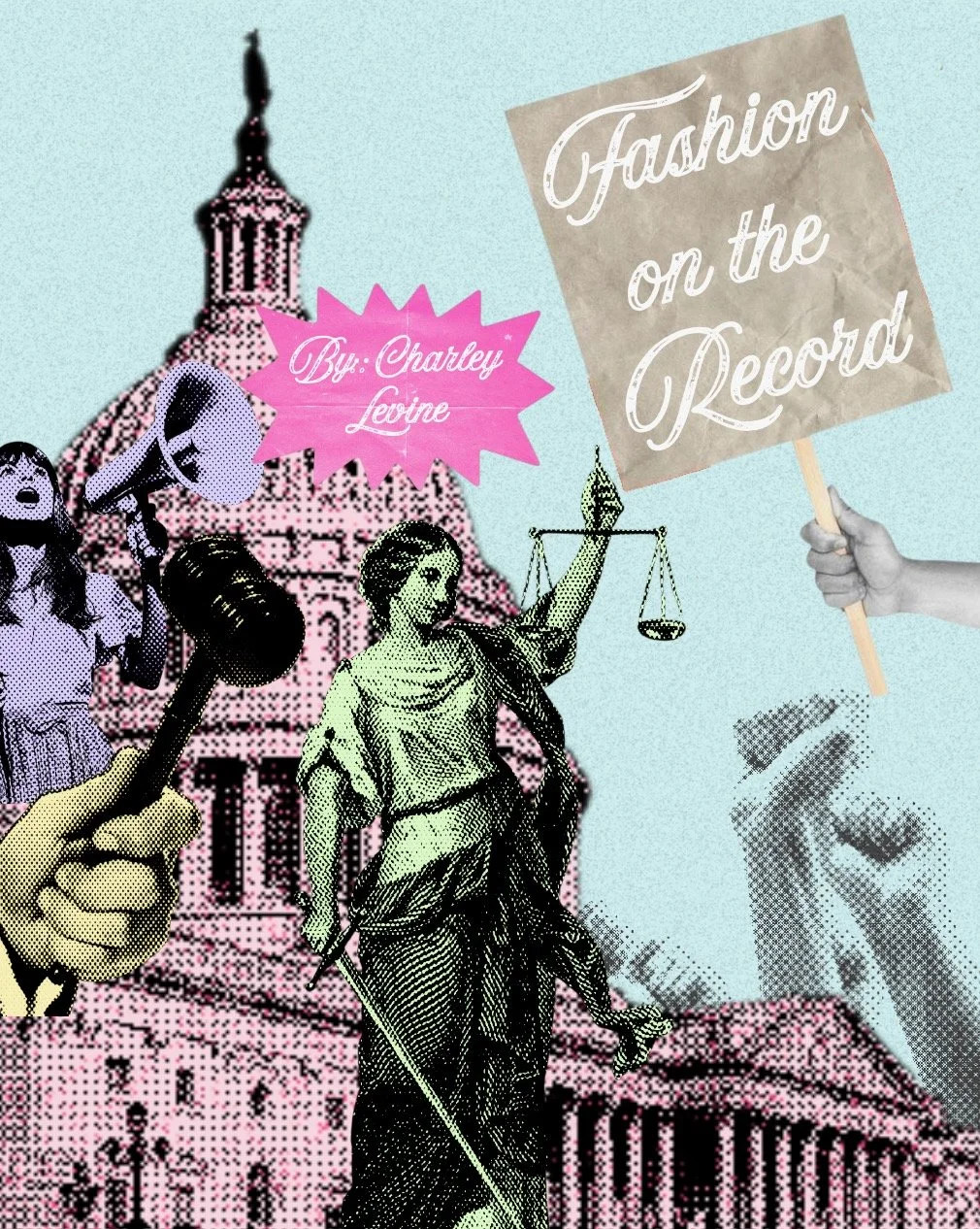
Graphics by Libe Wartski
On December 23, 2024, the air inside the Manhattan courtroom was heavy, charged with the solemnity of a capital murder case. Shackled at the ankles and escorted in by armed court officers, twenty-six-year-old Luigi Mangione sat at the defense table. He faced federal and state charges, including murder and terrorism, stemming from the targeted execution of UnitedHealthCare CEO Brian Thompson. Such allegations carried the weight of life imprisonment or the death penalty. Yet as images from the proceeding subsequently proliferated online, public attention fixated on an unexpected detail:
His sweater.
Layered over a crisp white collared shirt, Mangione’s burgundy crewneck became a viral fashion sensation. Social media users scrambled to identify the garment, initially misidentifying it as a $1,000 Maison Margiela design before tracing it to an $89.50 washable merino wool sweater from Nordstrom. Within just hours of Mangione’s court appearance, the item sold out across digital storefronts. Then came the flood of fan edits romanticizing his prep-school aesthetic. Suddenly, focus had shifted from the prosecutors’ case for calculated killing to social media posts praising his style, scrutinizing his look, and in some cases, openly expressing support for him.
We all know justice is supposed to be blind. In a court of law, defendants are presumed innocent until proven guilty, and verdicts are based on evidence. Defendant appearances and public sentiment should hold no weight. But in the court of public opinion, these principles do not necessarily hold. It seems that appearances carry a considerable amount of weight.
Although the frenzy surrounding Mangione’s sweater might seem like a unique phenomenon, the close relationship between courtroom fashion and public perception is hardly new. For decades, high-profile defendants have used their wardrobes to shape the narratives surrounding their trials.
During her 2019 grand larceny trial, fake heiress Anna Sorokin, better known as Anna Delvey, went so far as to hire celebrity stylist Anastasia Walker. Her courtroom appearances featured labels including Saint Laurent, Victoria Beckham, and Michael Kors. Her designer wardrobe attracted significant attention, helping to preserve the elite socialite persona at the heart of her fraud charges.
When Theranos founder Elizabeth Holmes faced federal fraud charges, she ditched her signature Steve Jobs-inspired black turtlenecks in favor of soft, conventional suits and maternal-coded silhouettes. The transformation marked a departure from her image as the formidable Silicon Valley founder whose company had collapsed amid allegations of fraud.
More recently, during his 2025 assault trial in Los Angeles, rapper A$AP Rocky wore custom Saint Laurent pinstripe suits, attracting fashion coverage even as he faced serious criminal charges. Looking at these cases alongside Mangione’s viral sweater, it is striking how easily a defendant’s fashion choices can become a story of its own, even overshadowing the allegations that brought them to the courtroom.
As psychological research confirms, people naturally rely on physical appearance to make quick, automatic assumptions about someone’s character and credibility. A mechanism that demonstrates this is the halo effect, which suggests a single positive trait, such as neatness, style, or physical attractiveness, may influence perceptions of unrelated qualities like trustworthiness or intelligence. Mangione’s burgundy crewneck, for instance, could project a sense of approachability that contrasts sharply with the severity of the allegations against him. Similarly, Holmes’s understated outfits and Rocky’s tailored suits may communicate professionalism, maturity, and respectability. While these impressions tell us little about whether a defendant committed a crime, they can influence how we perceive the person accused of it.
Beyond shaping public perception, this phenomenon has significant commercial implications. Mangione’s sweater became an overnight object of consumer demand. Anna Delvey’s court wardrobe generated extensive fashion coverage, while A$AP Rocky’s trial presented a particularly interesting example of fashion marketing amid controversy. Throughout his assault trial, Saint Laurent circulated press releases identifying his designer outfits, strategically omitting any mention of the legal proceedings. Such instances reveal how fashion brands and retailers can be entangled in high-profile criminal cases, and even benefit from the attention. But when brands capitalize on this publicity, where is the line between savvy marketing and the exploitation of serious criminal proceedings for commercial gain?
Courtroom fashion has undoubtedly become a powerful tool for shaping public perception. Yet the human tendency to form judgements based on appearances, even when the stakes are as high as someone’s guilt or innocence, raises troubling questions about our susceptibility to superficial impressions. We expect the justice system to look beyond appearances, but in the court of public opinion, we seem willing to let them shape our judgements. As courtroom appearances become only more intertwined with fashion and social media, will we become better at looking beyond the clothes, or more willing to let them shape our judgments?
“We expect the justice system to look beyond appearances, but in the court of public opinion, we seem willing to let them shape our judgements.”
More from this edition
Featured