How Low Can You Go?
November 10th, 2026
Maya Chertorisky
Graphics by Addy Mcnear
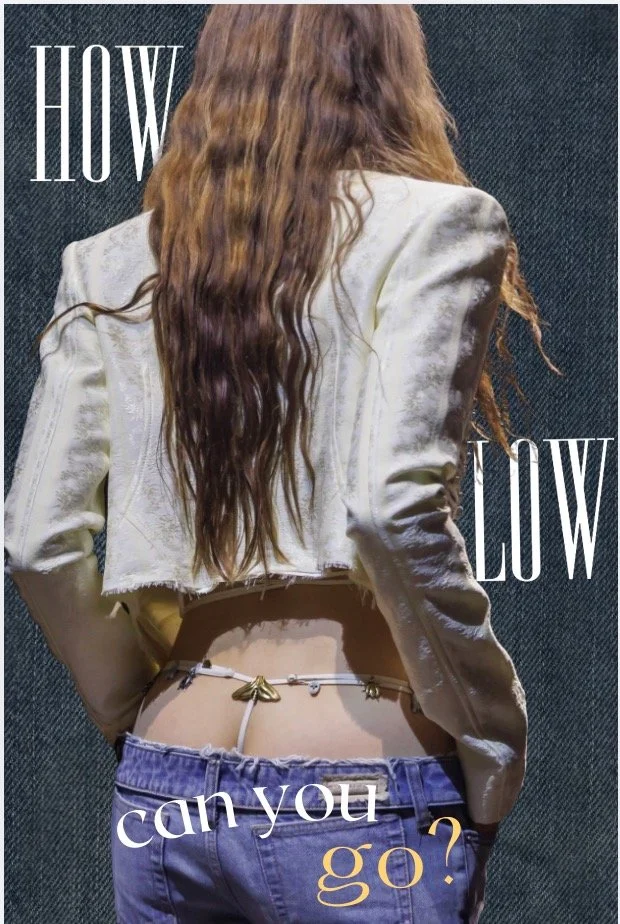
The revealing waistline of fashion’s most controversial design displayed much more than skin.
Alexander McQueen’s 1993 trousers dropped the waistline so low that they accentuated part of the upper buttocks. The revolutionary design, nicknamed the “bumster,” defied modesty conventions and instantly became one of the designer’s signature pieces. What started as a runway outrage became one of the key fashion trends of the early 2000s: low-rise jeans. As waistlines dropped, however, expectations for the female body rose.
McQueen introduced the bumster in his 1993 Taxi Driver collection, using unconventional tailoring to elongate the torso and emphasize the lower spine. As highlighted by the Metropolitan Museum of Art's Alexander McQueen: Savage Beauty exhibition, the designer aimed to transform the body's proportions rather than expose more skin. McQueen explained that he intended to elongate the body, not merely expose the backside.
Bumster was not just a new silhouette; it rejected the notion that certain areas of the body had to be concealed, making exhibitionism a form of art. Yet the very style that rejected conventional notions of decency would later reinforce its own set of standards.
By the early 2000s, low-rise jeans had moved away from the runway and into mainstream fashion. Celebrities such as Britney Spears and Paris Hilton played enormous roles in popularizing the trend, pairing barely-there waistlines with cropped tops that left much of the midriff exposed. As HISTORY's examination of controversial fashion trends illustrates, once-provocative styles can eventually become widely accepted. The low-rise silhouette became synonymous with Y2K fashion, but it was also closely associated with the era's restrictive beauty ideals.
The irony was not hard to miss. Even as the low-rise jeans suggested sexual liberation and self-assurance, the success of this fashion seemed to go hand in hand with the close examination of women’s bellies, hips, and waistlines. The body wasn't just wearing the fashion; in some ways, it became the fashion.
This raises an important contradiction within fashion's relationship with female empowerment. Revealing clothing is often celebrated as a rejection of traditional expectations surrounding modesty. However, when advertising and promotion disproportionately feature certain body types in those designs, the freedom to reveal more skin can become another source of pressure.
The controversy surrounding low-rise fashion therefore extends beyond how much of the body is exposed. It also concerns whose bodies are celebrated for wearing it.
Nearly three decades after McQueen's original design, low-rise silhouettes returned to the runway. In 2022, Vogue documented the revival of ultra-low-waisted trousers at fashion houses including Versace, Blumarine, and Coperni. Sarah Burton also revisited McQueen's signature silhouette for the house's Spring 2023 collection.
Fashion’s relationship with nostalgia prompted this comeback. Reviving recognizable shapes from earlier decades helps the trend reach younger consumers while also capitalizing on the cultural discourse around its rebirth. This way, the controversy that made low-rise pants so scandalous in the past is precisely what makes them memorable.
However, reviving the silhouette does not necessarily mean reviving the cultural ideas linked to it. Modern consumers have the opportunity to detach the clothes from the restrictive beauty ideals they once represented. Whether that shift becomes a reality depends, in part,on whose bodies the industry chooses to represent.
McQueen's bumsters originally challenged the boundaries of acceptable exposure. Their evolution into a mainstream trend reveals a more complicated relationship between rebellion and conformity. Fashion can challenge one set of societal expectations while reinforcing another.
Perhaps the real controversy was never how low the waistline could go, but how much scrutiny women were expected to endure when wearing it.
“Fashion can challenge one set of societal expectations while reinforcing another.”
More from this edition
Featured