John Galliano: The Price Tag on Forgiveness
November 10th, 2026
Lyanne Luu
Graphics by Milena McMahan
“No one more deserving of an exhibition of this scale,” Anna Wintour told Vogue about the Metropolitan Museum of Art’s announcement of the Spring 2027 Costume Institute exhibition and Met Gala theme, John Galliano: Horizons. Drawing on his work at Dior, Givenchy, Margiela, and John Galliano the label, Wintour remarked that Galliano is “a great designer and his career isn’t defined by a moment” (Phelps).
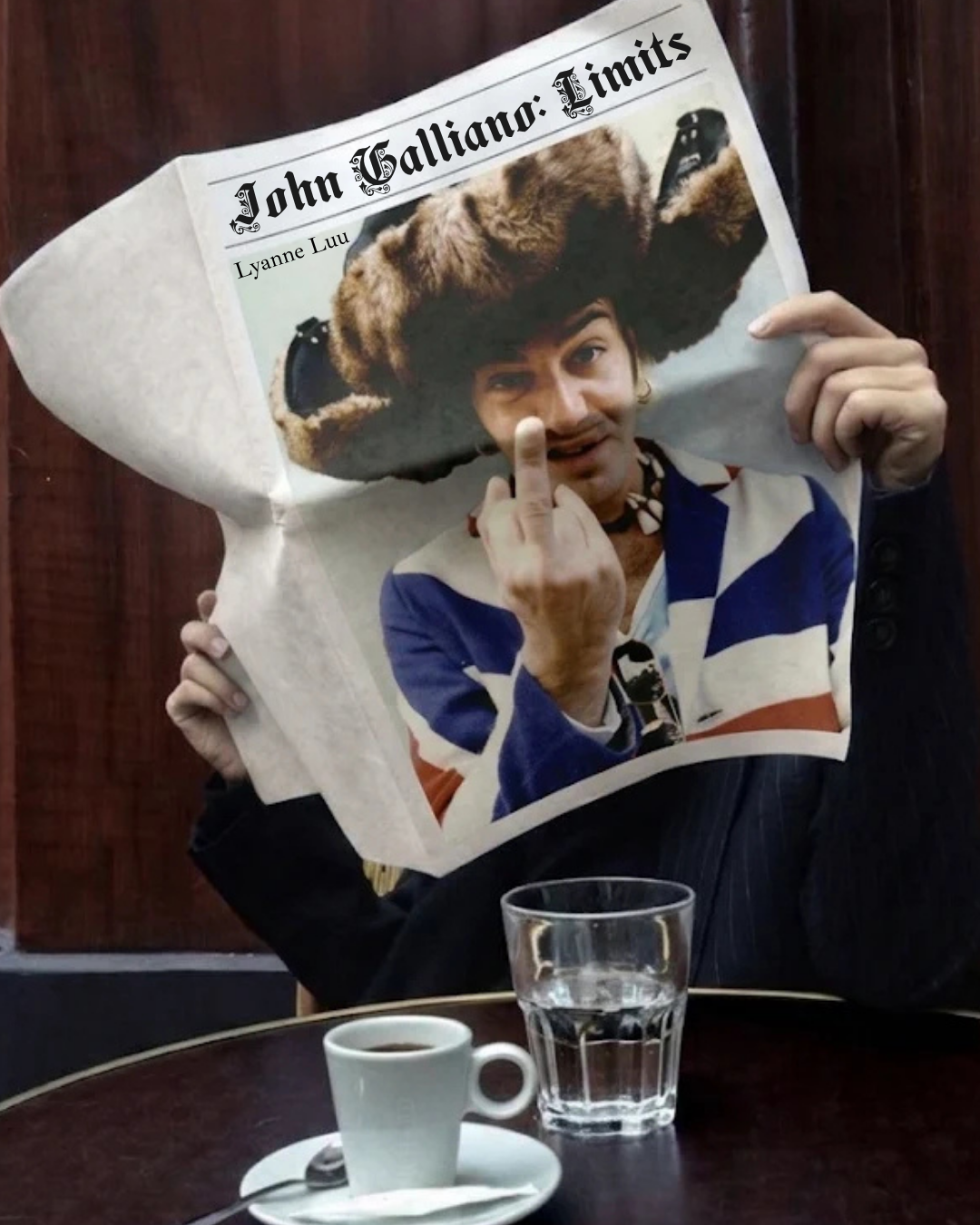
The moment in question? Galliano’s 2011 spree of antisemitic remarks filmed in a Paris bar. He was convicted in a Paris court for hate speech and was fired immediately from Dior.
Despite Wintour’s statement and the Gala curator’s meetings with Jewish leaders before announcing the theme, the exhibition was canceled by August 31st, less than a month after the announcement (Ghermezian). Galliano himself announced, “with great sadness,” that the show would not go ahead, a decision he and the museum had reached together. Now, the Met Gala is left with no theme.
So, does the moment define him? Does the moment supersede his body of work, his being hailed as one of “fashion’s greats,” even his four British Designer of the Year awards? The theme’s collapse begs the question: can an artist be separated from his art? If forgiveness is possible, who gets to grant it, what does it take to earn it, and how much is it worth?
The argument for him is simple: based on his work alone, few designers have a stronger claim to a Met retrospective. “Galliano is considered by many in the fashion world to be one of the most important contemporary designers” (NYT). For decades, he was heralded as a visionary who transformed haute couture runways from exhibits into spectacles. His debut collection, Les Incroyables, at Central Saint Martins in 1984 was immediately bought in full by the London Boutique Browns (Sotheby's). He quickly went on to lead Givenchy, then Dior, for 15 years. His work has been hailed as “designs of the highest art form” (Sotheby’s).
When he returned to a creative director role at Maison Margiela in 2014, Galliano once again proved his genius. At Margiela, he was credited with rejuvenating the brand’s identity through boundary-pushing, storytelling designs. For Spring 2020, he introduced décortiqué, a signature technique that cut away sections of a garment to leave only its skeleton. He gave new life to the house’s iconic split-toe Tabi, and they have reappeared season after season. His Spring 2024 Artisanal show, staged beneath a Paris bridge with porcelain-skinned models moving through a seedy, cinematic dreamscape, became one of the most talked-about shows of the decade. It felt like the industry was craving his talent, even if many weren’t ready to welcome him back.
Galliano’s influence on fashion is indisputable: his work has redefined fashion boundaries, and his craftsmanship has transformed industry perspectives. Artistically, most see him as a visionary and a genius. In fact, the Met holds the world's largest collection of his work. So to the 2027 Gala theme’s defenders, honoring Galliano was overdue.
On the other hand, the reason to cancel it is just as clear. In 2011, he was filmed at a Paris bar making disgusting anti-Semitic commentary, including praise for Hitler. On the same night, he yelled slurs at an Asian man, threatening and degrading him.
His offenses extend into his work too. Galliano’s Fall/Winter 1996/97 collection for his namesake label featured a white model portraying Pocahontas, the “Cherokee babe,” a tribe Pocahontas did not even belong to. Galliano’s work raises the question of when inspiration becomes appropriation or disrespect.
In his public statements and apologies, Galliano has acknowledged the hurt he caused to both communities. He pointed to his alcoholism, the recent loss of his closest friend, and his unhealthy relationship with drugs as the reasoning behind his actions. He stated having “no recollection” of the incident, a result of being on valium, sleeping pills, and drinking.
Having lost his position at Dior and spending two months in rehab immediately following the incident, Galliano spent the following year getting sober and studying Judaism with rabbis. Denounced by LVMH and major critics in the fashion community, Galliano went into fashion ‘exile.’ The video became one of the most infamous moments in fashion history, a fashion legend's fall from grace, making it all the more surprising when fashion ‘forgave’ him.
Only two years after the altercation, Galliano took a temporary residency in Oscar de la Renta's studio, an arrangement Wintour helped broker. In 2014, he became creative director of Maison Margiela, a decade-long tenure allowing him to rebuild his reputation as a working designer rather than a cautionary tale. His 2024 Spring/Summer collection marked his revival, described as an “electrifying reminder of Galliano’s genius and creativity.” He left Margiela at the end of 2024 on a creative high.
The industry’s re-embrace raises even harder questions: What truly signifies atonement? Is there a standard for forgiveness? It seemed that, collection by collection, fashion decided Galliano was once again employable, but the Met Gala doesn’t hand out jobs. It hands out honors.
The Met assessed the risks before officially announcing its intentions to spotlight Galliano’s work at the Gala. Prior to the announcement, Wintour, Galliano, and curator Andrew Bolton met privately with prominent New York rabbis and Jewish leaders, including Rabbi Rick Jacobs of the Union for Reform Judaism, who publicly backed the show. The exhibition promised to address the 2011 incident directly, but maintained it was about his work, not his personhood: "Whether Galliano can be forgiven is not a question the exhibition seeks to answer."
Critics answered it anyway. The Gala faced instant backlash. New York City Council Speaker Julie Menin wrote to the museum's leadership calling the choice a serious mistake. The Anti-Defamation League said it was consulted only after the show had been announced. Jewish fashion editor Tania Leslau argued in The Jewish Chronicle that the honor had "given antisemitism a hall pass," while still calling Galliano a creative genius.
Acknowledging the pain he had caused to the Jewish and Asian communities and the resurfacing of that harm through the Gala, Galliano withdrew on August 31.
His withdrawal is a business case of forgiveness: Galliano may no longer be exiled; he may be sellable, but not honorable. In March 2026, Zara announced a two-year creative partnership with him, his first ever with a mass-market retailer. The commercial industry may plaster his name across labels, and he may be hailed as a “great,” but luxury fashion can never separate his name from his scandal.
In the same season, the world’s biggest fashion retailer was happy to put his name on a product, while the world's most famous museum could not put it on a wall. Galliano is the subject of a two-tier redemption economy. Hiring someone is a commercial transaction. Honoring someone is a moral statement. Galliano may have climbed the first tier, but was in fact not prepared for the second.
But will his Met fallout follow up in this commercial transaction? If Zara’s Galliano collections are successful, what will that say about fashion as an art when you are buying it versus admiring it?
The Met Gala is a fundraiser and the Costume Institute’s main source of funding. The theme is a product in itself, sold to donors and onlookers. Allegedly, some donors told Met executives they planned to withdraw donations if the Galliano theme went into fruition. So the line was drawn by the people paying for the party. As it turns out, fashion’s moral line has a price tag, and the donors get to set it.
The Galliano case suggests fashion has already settled the matter: yes, at the register, and no, on the pedestal. Yes, we can study him, and no, we cannot celebrate him. Fashion should cross the line in terms of creativity and aesthetics, just as Galliano’s rise to fame was made possible by eccentric new ideas that the industry had never seen. Galliano’s case reminds us that in fashion, the line has never been moral. It has always been aesthetic.
“a great designer and his career isn’t defined by a moment”
More from this edition
Featured