Not the Bride, Butt Everyone's Looking: Pippa Middleton and the Fear of Upstaging the Wedding
November 10th, 2026
Madeline Bram
Graphics by Chloe Hackett
On April 29, 2011, hundreds of millions of people tuned in to watch Kate Middleton marry Prince William at Westminster Abbey. Her walk down the aisle was, in effect, the biggest catwalk in fashion history. One look, seen live by a larger audience than any runway show has ever reached. Middleton's Alexander McQueen gown, designed by Sarah Burton, was the most anticipated dress in the world at the time, and it did not disappoint.
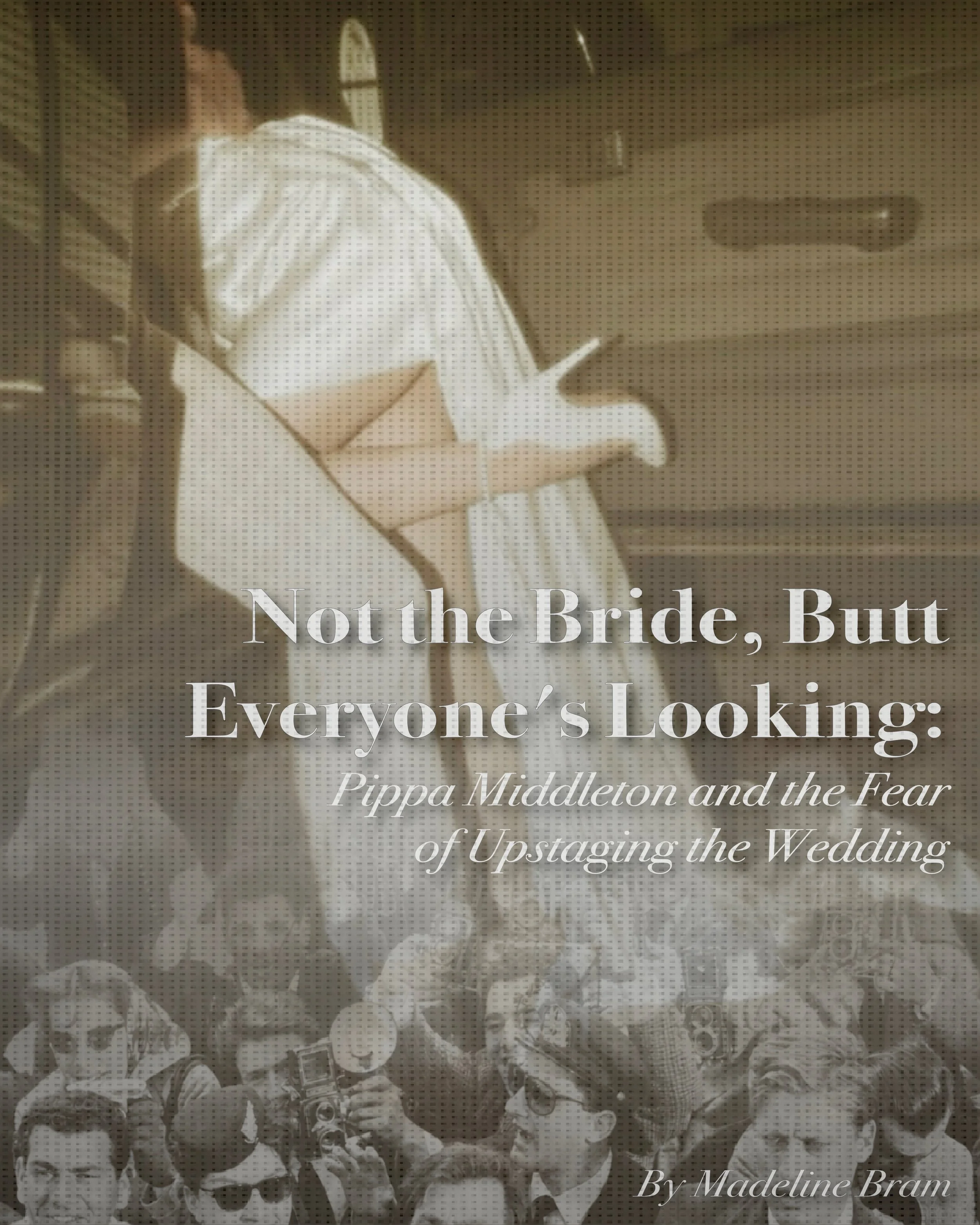
But a second dress took over part of the conversation. Walking behind the bride and carrying her train was her sister and maid of honor, Pippa Middleton, in a sleek ivory column gown by the same designer. Within hours, the internet was flooded with talk of her backside as much as the bride's dress. A Twitter account devoted to it reportedly had 1,000 followers before the day was even over.
Most fashion scandals begin with someone trying to provoke. Pippa's began with a dress tastefully designed, by her own account, to blend in.
That moment raises a bigger question: why has dressing for a wedding become so rule-bound and fear-driven? Never wear white. Never show too much skin. Never “outshine” the bride. No real authority enforces these rules. People police them in group chats, on TikTok, in etiquette columns, and in Reddit's "Am I the A-hole" (AITA) threads, where strangers act as judge, jury, and executioner.
So who is really on trial when an item of clothing becomes controversial, even though the person wearing it didn't intend to stir up discourse? And is the modern wedding guest dressing for a celebration of love, or to avoid blame and an onslaught of hate?
Pippa's dress had an intention of invisibility. In one of her first interviews about it, she said the dress was never meant to be significant, just to blend in with the train. The ivory column was deliberately designed to complement the bride's gown. She has commented on the global attention as both flattering and embarrassing, and said she did not grasp the scale of the day until afterward.
The public latched on to the story immediately. People set up a Facebook group in her honor. Tabloids and fan pages scrutinized her figure. One French royal commentator went on television and declared, with no evidence, that she must have had a "false bottom". While some could argue that a larger posterior is now a beauty standard, notably exemplified by celebrities like c the Kardashians, beauty standards of the time were different, and not always complimentary. Now, there are threads [I need to remember to add a link here] dedicated to laughing at the absurdity of ‘Backside gate,’ since, by all accounts, compared to current celebrity rears, Pippa’s isn't all that newsworthy.
Regardless of whether having a larger backside was considered a positive trait, Pippa was simply a woman standing at her sister's wedding in a floor-length dress with cap sleeves and a column of buttons up the back, with no desire to become the center of a salacious campaign about a private part of her anatomy.
Pippa, to her credit, answered with a joke. Recognition, she told one audience, has its upside, its downside and its backside.
But the joke hides a real question. In a courtroom, intent matters: it is often the difference between an accident and a crime. Pippa's "offense" existed entirely in the reaction: the tabloids, the fan pages and the endless commentary on her body. Can a scandal exist if the wearer never committed one? And if intention matters in a real court, why does it matter not at all in the court of public opinion?
The rule that only the bride wears white originates from a custom less than two centuries old. Queen Victoria married Prince Albert on February 10, 1840, in a white satin gown trimmed with Honiton lace, and the look spread across the Western world in the decades that followed.
The meaning came even later. White had long been tied to mourning, and to wealth, because only people with the means to clean their clothes could keep it spotless. It was the media that declared it the emblem of girlhood innocence, and that is how a color acquired its associations with purity and virginity. These ideas are outdated, but they explain why wearing white to someone else's wedding still feels like sacrilege rather than a fashion mistake.
The wedding guest economy thrives on these anxieties. Retailers now maintain dedicated "wedding guest" categories, while rental services built around the idea of wearing a dress once, fueled by fear of committing cardinal wedding guest sins and crimes. Rent the Runway, for example, lists a Rabanne dress that retails for $1,500 and rents for $35 over four days, and one guide counted more than 750 designer brands in its catalog. A sponsored guide for the service promises that a patterned slip dress lowers your odds of accidentally matching a bridesmaid, which tells you what the shopper is assumed to be afraid of.
Pippa Middleton has said the dress still hangs in her wardrobe and that she hasn't worn it again, but the trial it started went on without it. The rules -don't wear white, don't show too much, don't look better than the bride - existed long before Pippa and have since moved to larger juries and faster verdicts. Anyone who has stood in a fitting room the week before a wedding, asking whether a dress is "too much," knows who the real defendant is: the wearer, tried in advance for a crime nobody has defined. So is the modern wedding guest dressing to celebrate or to avoid blame? If the answer is mostly to blame, then the question becomes who benefits from that fear, and what a wedding might look like if guests were allowed to simply show up, as showing up for who you love, paparazzi or not, is what truly matters.
“why has dressing for a wedding become so rule-bound and fear-driven?”
More from this edition
Featured