Sacrilegious Silhouettes
November 10th, 2026
Avery Cannan
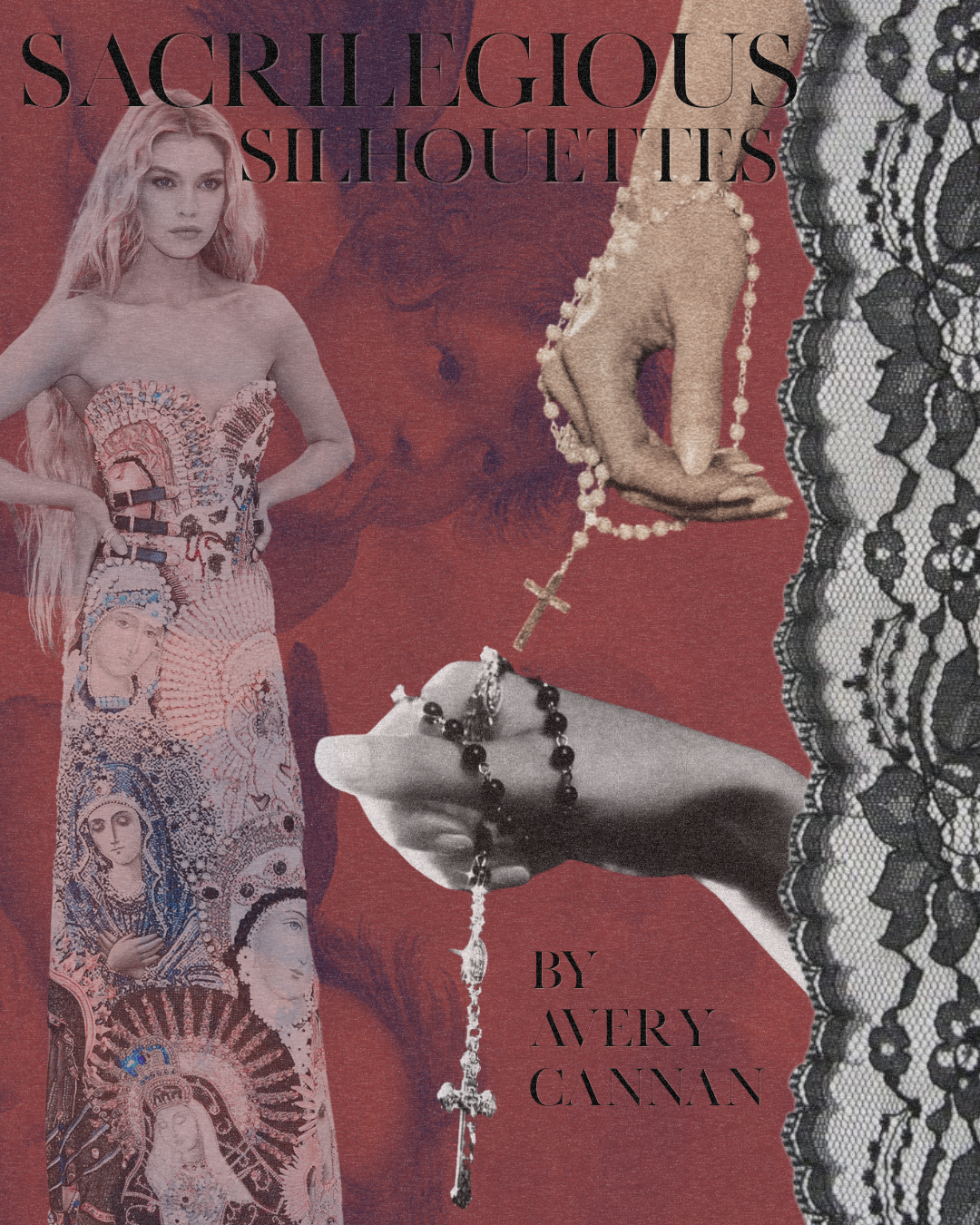
Graphics by Lila Garwood
“With consent and participation from the Church, a use of Catholic imagery becomes an appreciation rather than an appropriation.”
The Christian Dior Fall 2000 Couture show by John Galliano opened with an opulently adorned Pope drenched in gold ornaments walking down the runway swinging a censer. This striking image exemplifies the intersection between haute couture and the Catholic Church, whose visual traditions have provided fashion designers a wealth of artistic inspiration for decades.
The biggest fashion houses in the west are located in France, Italy, and Spain — countries whose histories are deeply rooted in the Catholic tradition. Their religious heritage plays a part in shaping the aesthetic sensibilities and attitudes of the designers behind these houses, allowing the Catholic Church to shine through the garments they create. The Church’s use of beautiful art coupled with lustrous ornaments, vessels, and architecture makes the Catholic “aesthetic” very desirable for its wealthy and grandiose appearance.
Despite the intuitive relationship between Catholicism and couture, there have been many controversies in the fashion realm on the basis of the perceived misappropriation of the Church. Allusion to Catholic imagery often results in either heavy scrutiny or high praise. But what really makes its use interesting versus offensive in the public eye?
Borrowing from Catholic aesthetics is not always received negatively, in fact it has frequently piqued public interest in designer fashion. The 2018 MET Gala featured celebrities in a plethora of Vatican-inspired pieces. The red carpet showcased religious iconography through jeweled crosses, gold embroidery, and papal silhouettes. Elaborate headpieces and religiously embellished gowns cultivated an extravagant celebration of Catholic art.
Following this resplendent display of Catholicism, the correlating exhibition “Heavenly Bodies: Fashion and the Catholic Imagination” became the most visited installation in the costume institute's history with over 1.6 million visitors. This specific use of Catholic imagery was consigned by the Vatican as well, with the Church sending 41 items to be displayed at the MET for this exhibit.
While acknowledging this well received use of Catholic aesthetics, the public lashes out if there is a hint of sacrilege, such as association with sex, disrespect towards the religion, etcetera. In 1989, Pepsi pulled out of a multi-million dollar commercial deal with Madonna in reaction to public backlash towards her “Like a Prayer” music video featuring controversial religious implications, burning crosses, and sexual themes.
Beyond this extreme example, there have been smaller instances of public scrutiny towards companies or individuals for referencing the Catholic Church at all. Sabrina Carpenter sparked repeated controversy with her “Feather” music video being set in a Brooklyn church and then with her response including the statement “Jesus was a carpenter,” referencing her own last name.
Unlike the two examples that garnered backlash, the MET’s engagement with Catholicism was accompanied by a consent and participation given to the museum by the Church. This could perhaps reveal something about what actually makes a reference to Catholicism offensive or sacrilegious in the cultural climate. With consent and participation from the Church, a use of Catholic imagery becomes an appreciation rather than an appropriation. It then becomes up to companies, people, and the fashion community at large to decide how they want to engage with Catholicism. There is a very high likelihood for both profit and loss when referencing the Church in pop culture — it just comes down to audience, application, and consent.
Fashion using Catholicism we have heard about, but there is also the alternative in which Catholicism uses fashion. Popes are known for the unique sartorial choices that they bring to the Vatican, with some like Pope Francis adopting a modest and plain style, and others like Pope Benedict XVI embracing something more ornate and elaborate. These choices reveal the character a Pope hopes to bring to his papacy, and they show that the Church, too, uses fashion to express its values, identity, and vision for the future.
A recommendation for parties aiming to reference the Church would be to use its imagery intentionally and respectfully, recognizing that fashion and Catholicism do not need to be mutually exclusive. When brought together thoughtfully, the two can create a beautiful amalgamation of faith, culture, and artistic expression.
More from this edition
Featured