The New Lengths of Rebellion
November 10th, 2026
Hayley Ganis
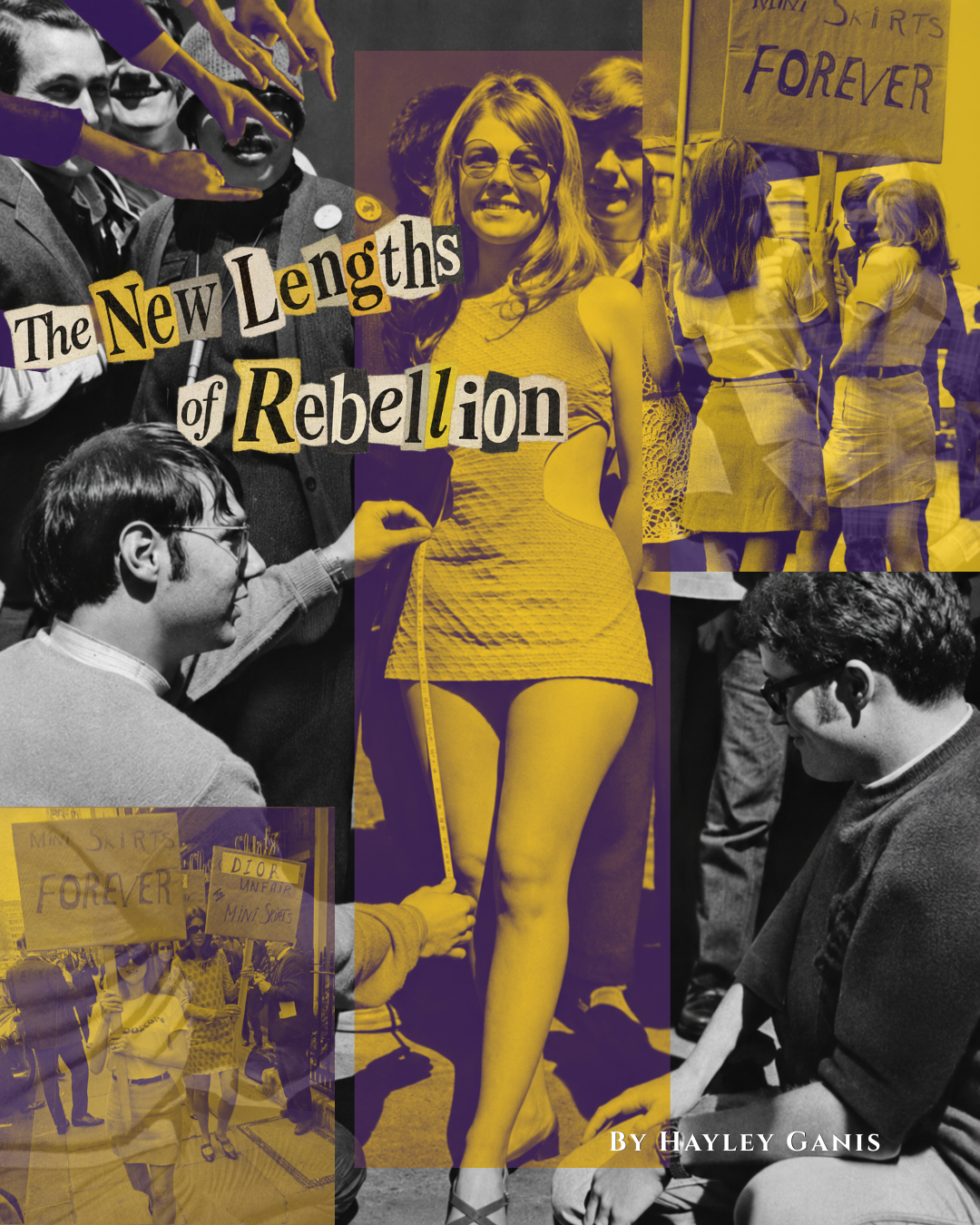
Graphics by Natalia James
“Skirts should be the size of a belt. Life’s short. Take risks,” Paris Hilton famously quips, referring to her signature ultra-low-rise, micro skirts that defined Y2K fashion and culture.
Hilton wasn't wrong. The mini skirt, no matter the style or era, has been fashion's ultimate risk since it emerged in the 1960s. While Mary Quant, a British designer and owner of the boutique Bazaar, commercialized the garment and is largely credited with it, other designers like André Courrèges were also among the first to create the abbreviated silhouette. These designers drew inspiration from the rebellious, playful energy of a younger generation that demanded skirts that were more comfortable and free-spirited. In fact, the name “miniskirt” was coined after Quant’s favorite car, the Mini Cooper: fun, modern, and small.
The mini-skirt represented a starkly different lifestyle than decades prior. Following the end of WWII in 1945, high fashion took a distinctly conservative and traditional turn as a cultural response to the instability of war. Christian Dior, for example, introduced his “New Look” in 1947, characterized by cinched waists and voluminous skirts that emphasized a traditionally feminine silhouette. By the 1960s, however, the rise of counterculture led the younger generation to reject these models in favor of more rebellious, shocking, and risky fashion choices. Quant’s mini-skirt instantaneously rocked the fashion world and certainly turned heads, but not always in a good way.
Many condemned mini-skirts as immodest, inappropriate, and scandalous. Famous designers such as Coco Chanel deemed it “disgusting,” and House of Dior refused to showcase them on their runway. These objections revealed deeper truths about society and femininity beyond the aesthetic purpose of missing a couple of inches of fabric. The backlash exposed the ways women’s bodies are subjected to social regulation, ridicule, and patriarchal expectations of modesty. Miniskirts were blamed for corrupting the morality of youth, deteriorating women’s health, and destroying women’s feminine charms and respectability. High schools across the country banned the style, claiming that the short lengths led to a “distraction” among fellow students, and employers prohibited their workers from wearing minis to the office.
The younger generation of women, however, understood the political value of the mini skirt, for the movement was about more than a woman having autonomy over her legs; it was about gaining power over her life, femininity, and freedom. They defended it fiercely, with some even forming the British Society for the Protection of Mini Skirts. Accompanied by the newfound widespread availability of birth control in the 1960s, women linked the mini-skirt to a statement about bodily and sexual autonomy. Quant herself is quoted as saying that “the mini skirt was a way of rebelling.” These sentiments quickly spread through mainstream media: from Audrey Hepburn rocking the garment in How to Steal a Million (1966) to supermodels like Twiggy on the front pages of fashion magazines, the mini-skirt became a defining piece of 1960s fashion.
As the miniskirt became increasingly accepted into mainstream culture, its meaning evolved through music, film, and celebrity culture. In the 1970s, Debbie Harry’s punk-inspired style associated short hemlines with rebellious self-expression. The 1980s brought the playful ra-ra skirt, and the 1990s showcased schoolgirl, pleated-style skirts through movies such as Clueless (1995), Britney Spears’s “...Baby One More Time” music video (1998), and Christina Aguilera’s “Dirrty” (2002). By the 2000s, hemlines grew even more minuscule with denim mini-skirts and Y2K fashion.
Even as the miniskirt has become more commercialized in mainstream culture, it continues to invoke contradictory responses regarding a reclamation of femininity and deeply misogynistic declarations. For example, in 1997, Rolling Stone magazine referred to 90s icons such as Christina Aguilera and Jessica Simpson as “selling themselves as feminist cheesecake" because they showed a little leg. In a shockingly recent incident this past year, Antonio Tajani, Italy’s deputy prime minister, used a marriage analogy—describing what he would advise his son to look for in a partner— to avoid a more glamorous or flashy woman because she could be prone to instability or infidelity, whereas a "more serious woman" who wears a "longer skirt" would be more reliable, faithful, and a good mother. These comments, while unfortunate, are not isolated examples. They paint a broader picture of the misguided conflation of morality and modesty. The original purpose of the mini skirt - to reclaim female autonomy and femininity - seems to have taken on a double connotation of enhancing sexuality and proactiveness. While these two narratives can be true at the same time, some have used them as an excuse to turn the mini-skirt into a measuring stick for a woman’s value and worth.
While misogyny continues to paint a patriarchal story of the mini-skirt, the garment has undeniably lost some of the “shock factor” that first caused it to radicalize the market. Short hemlines no longer attract much of a second glance. They have become a staple of everyday wear, not something you exclusively see in magazines or among the younger, more progressive generation. Many designers now seem to have recognized that the original selling point of mini-skirts has lost the drama that once commercialized the garment. Thus, brands such as Miu Miu and Diesel have tried to bring attention back to the mini-skirt by using new methods to spark controversy.
Miu Miu’s Spring/Summer 2022 collection introduced the “micro-mini”, a skirt that was genuinely “as short as a belt” that left little room for practicality. This contrasts sharply with Mary Quant’s original mini-skirt, which was meant to increase the comfort and practicality of women’s fashion. While Quant’s skirt embraced hyper-femininity, Miu Miu’s boxy, boyishly designed silhouettes do not carry overt sexual or feminine connotations, despite the clothing being strikingly short.
We see similar patterns in Diesel’s Fall/Winter 2022 Runway show, which sported leather “belt-skirts” that restrict movement to a stiff shuffle, or in athletes like tennis star Serena Williams showcasing denim with knee-high boxing boots during one of her matches. These new designs have taken hold, influencing other collections such as Danielle Guizio’s viral micro miniskirt. It begs the question: has the mini-skirt lost its original purpose in the ever-radicalizing scramble for a new “shock” factor? Or has the mini-skirt evolved and adapted to changing times and fashion standards? As the fashion industry continues to progress, it will be interesting to see what direction the mini-skirt takes in the designer's ever-evolving mission to capture consumer and market attention.
Blurb: From the rebellious streets of 1960s London to the micro-minis of today’s runways, the mini skirt has always been more than just a fashion statement. This article explores the garment’s evolution as a symbol of female liberation, self-expression, and patriarchal scrutiny, examining how its original message of autonomy has been reshaped by celebrity culture, commercialization, and the fashion industry’s endless pursuit of shock value.
“…for the movement was about more than a woman having autonomy over her legs; it was about gaining power over her life, femininity, and freedom..”
More from this edition
Featured