Who Wears the Pants?
November 10th, 2026
Cameron Brown
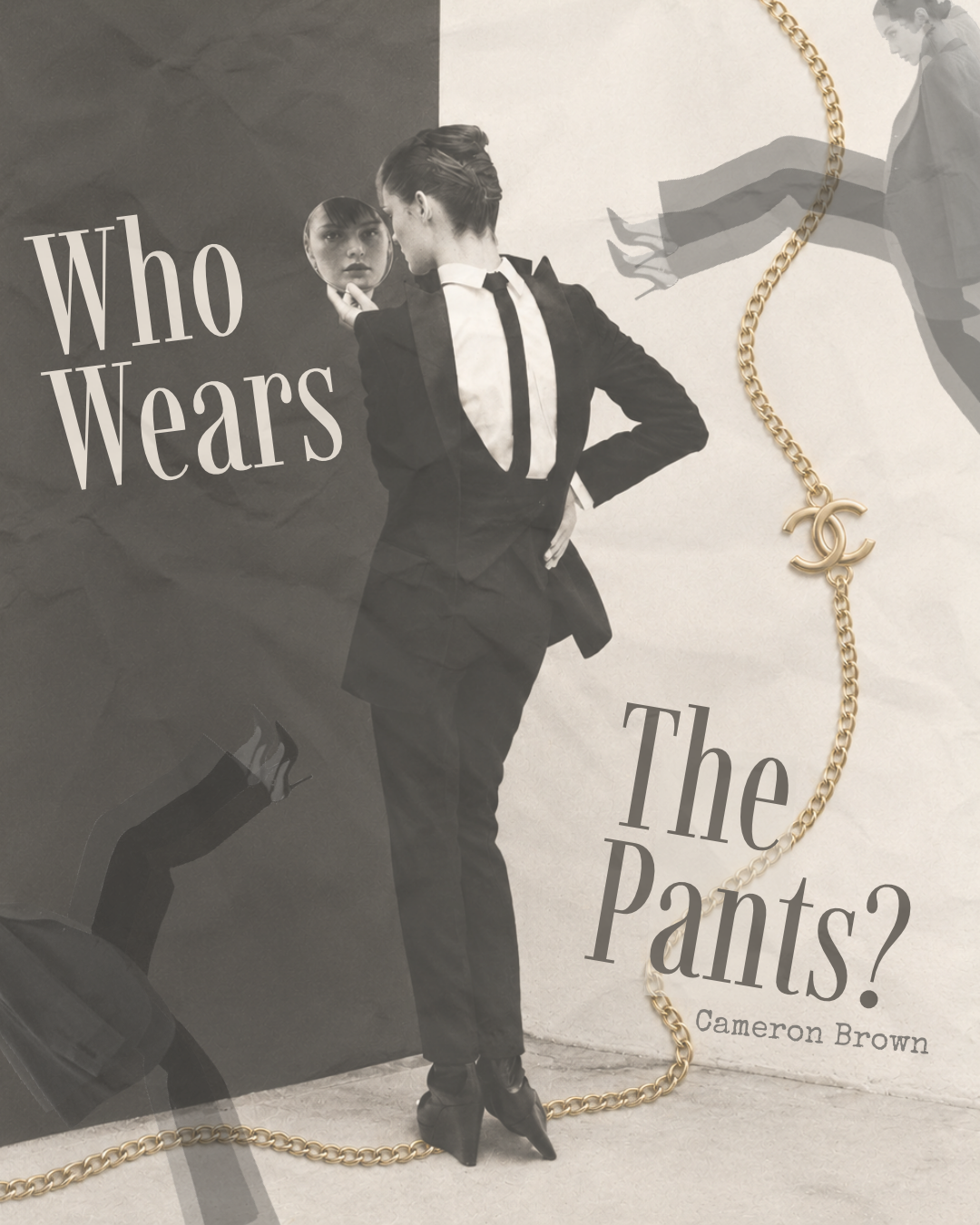
Graphics by Caroline Block
In the 1920s, one of fashion’s biggest powerhouses was denied entry to a French Riviera casino. Citing a strict, traditional dress code, the casino’s owner rejected Coco Chanel and her new idea of “beach pajamas,” making it clear she was "living proof that one must not be merely dressed, but well dressed.”
Today, seeing a woman in pants is nothing more than unremarkable. The idea that something as simple as trousers was once controversial seems otherworldly. A century ago, however, women wearing pants made a bold statement about their femininity and their social standing. While Chanel didn’t invent women’s trousers, she helped elevate the garment’s prestige in a way that no one else could. By making herself the advertisement and rebranding pants by controlling the name, she turned an item tied to masculinity and labor into a status symbol.
Before trousers became everyday attire for women, they were a uniform. During World War I, increasing numbers of women entered factories to support war efforts. Many transitioned from long restrictive skirts that limited mobility to trousers, improving efficiency to meet strenuous job demands. Even under extenuating circumstances, women wearing pants continued to face social disapproval.
This is what made such a simple garment so stigmatized. Trousers were more than a practical clothing choice; they signaled a departure from traditional feminine expectations, women tapping into masculinity and manual labor. In polite society, respectable women were expected to wear skirts and adhere to conventions of dress. For a designer catering to Europe’s upper class, these associations introduced a challenge.
So how do you make something taboo feel exclusive?
Chanel’s answer predates Runway. As a widely respected public figure, Chanel became a walking advertisement, with photographs of her wearing pants accomplishing what traditional print ads could not. It inspired style, showing women could work comfortably without sacrificing their elegance.
As early as 1918, Chanel began serving as her own advertisement by wearing loose trousers on the Riviera, usually ones borrowed from sailors or male companions. Vacationing in France, she borrowed these pyjama-style pants, sometimes taken straight from lovers’ wardrobes, and transformed it into an outfit. Where the wealthy went to be seen, Chanel was seen in pants. Deauville, Venice's Lido, and Juan-les-Pins made Chanel a walking billboard, normalizing the garment and attaching status to it, a calculated introduction of the trend.
This was founder-led marketing before anyone knew the term.
Marketing trousers as everyday womenswear would have been a radical proposition. Instead, she tactically labeled them as beach pajamas: ultra-wide, flowing pants paired with a blouse, inspired by 'sailors' pants.
Meant for the sand, this positioning made the trend seem far more specific: a garment limited to vacationing or resort wear, rather than threatening the societal norms of acceptable, public attire. Additionally, the ultra-wide fit was a smooth transition from long skirts and pants. Chanel’s wide-legged yachting trousers bridged this divide by resembling the silhouette of a skirt when standing still, situating the trousers as a staple in wealthy women’s wardrobes by the mid-1920s.
By introducing a controversial style to a small but influential market, Chanel managed to avoid high-pressure publicity. As beach pajamas gained traction among wealthy vacationers, the trend eventually reached a much broader consumer base. By the late 1920s, beach pajamas appeared beyond exclusive resorts and were seen on ordinary beaches, although trousers were still frowned upon off the shore for decades to come.
Beyond her approach to marketing , Chanel reinvented material. Before being universally accepted as a luxury fabric, Jersey was an inexpensive knit used primarily for men’s underwear and leisurewear. She built her early collections around the less-than-lavish material, turning it into a symbol of effortless elegance. By1916, Vogue recognized her mastery of the fabricas its stylishness stemmed from Chanel’s meticulous tailoring and draping.
Chanel’s everlasting influence proves that pants were never the point. A simple yet monumental step for women’s fashion and accessibility; her branding permanently shaped how clothing was marketed and perceived.. How a product is categorized and where it's worn can be just as important as the product itself. Beach pajamas slowly gained traction and popularity until pants became the norm. “Athleisure” brought leggings out of the gym and into town, and “loungewear” brought sweatpants out of the house. Trends don’t always have to emerge through revolution or shock value; with the right branding and influence of those we aspire to emulate, they can become part of everyday fashion over time.
“Chanel’s everlasting influence proves that pants were never the point.”
More from this edition
Featured