Christian Dior: New Look, Old Grievances
November 10th, 2026
Milena McMahan
Graphics by Milena McMahan
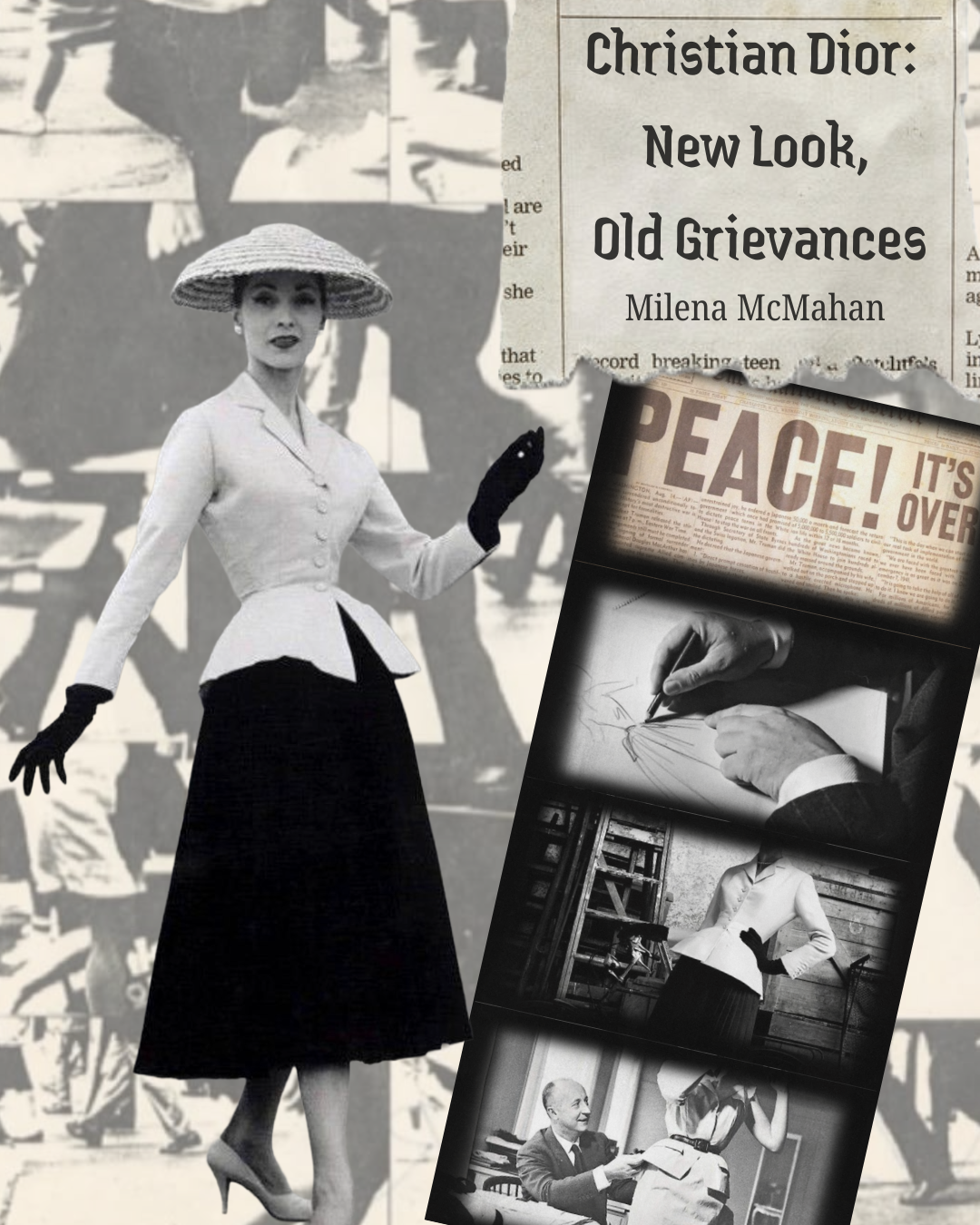
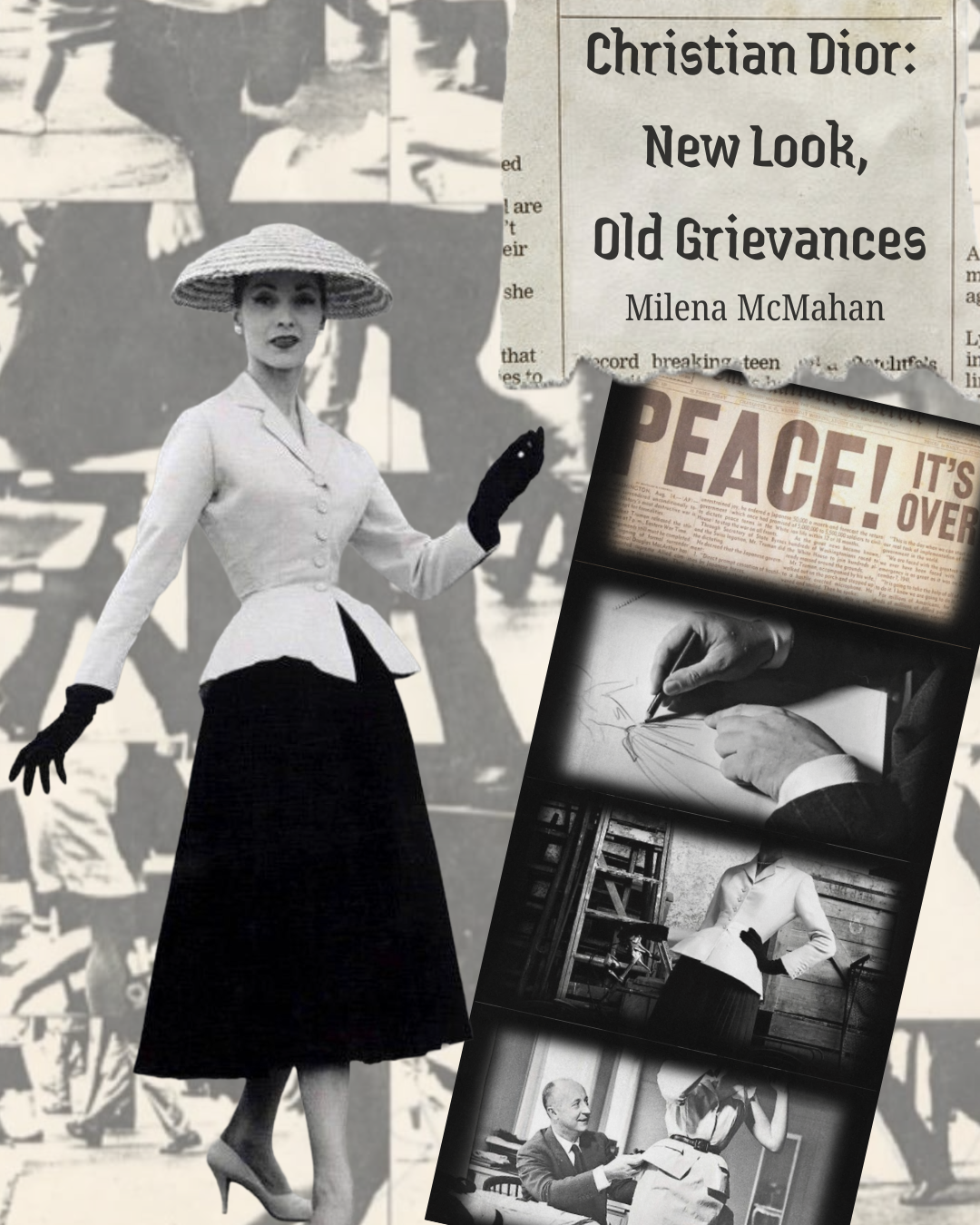
In February of 1947, a war-famished Europe, still rationing and recovering, was hungry for a new look. Its once drab, severe, and shapeless clothing was set to meet its match. Christian Dior’s debut collection would soon satisfy that hunger. Soft shoulders, a cinched waist, and a skirt that billowed out behind in a sea of fabric. As Dior said himself, “I turned them into flowers, with soft shoulders, blooming bosoms, waists slim as vine stems, and skirts opening up like blossoms”. Within months, women wearing his flowers would be chased down streets, and picketers would be waiting outside his shows. The question was never really whether the dress was beautiful, but whether anyone was allowed to want a beautiful dress yet.
To anyone still living on ration cards, Dior’s skirts weren’t just voluminous; they were wasteful, and the waste felt personal. At a time when Europe was still rationing necessities, such extravagance seemed unpatriotic. As a result, many fought back to drag women back into restrictive, old-fashioned dress. How, in a time so sparse, could women justify this deliberate extravagance?
Not only was he met with criticism from the public, but also his fellow industry peers. Coco Chanel quipped, “Look how ridiculous these women are, wearing clothes by a man who doesn’t know women, never had one, and dreams of being one.” Yet she could not be more wrong. In fact, he was strikingly close to many women in his life who deeply respected him. Not only did they love him, but they loved how his clothes made them look and feel. His muses, colleagues, and friends were all talented women who shaped Dior into what it still remains today.
Although these garments felt so drastically different, they represented a cultural divide evident in more than just the fabric. The New Look had become a place to put everything people were feeling out on the table: resentment, exhaustion, and fear of going back. After years of wartime devastation and the Nazi regime bleeding Europe of its comfort and its people, a skirt this lavish struck many as a slap in the face. Yet the man accused of this frivolity had lived so close to the war’s cruelty himself. His sister, Catherine Dior, was a French Resistance Fighter. The Gestapo arrested her in July 1944, tortured her, and deported her to Ravensbrück. When Christian met her at the station after the war, he could not recognize her. The designer who talked about turning women into flowers knew exactly what they had survived, and how their beauty must shine through their pain once again.
During the war, women’s clothing was purely functional. They were left with keeping households, hospitals, and factories running. Their clothing reflected exactly that: boxy, short, and built for movement. Dior’s collection almost asked them to step back into a more restrictive role, one defined by decoration, domesticity, and extravagance. As many questioned what this newfound beauty would cost them, others saw the opposite.
While this move felt so unfairly indulgent to many, after years of austerity, many women welcomed the femininity and lavishness as relief. The silhouette went on to define the late 1940s and 1950s. At a time when survival took precedence over style, Dior restored decoration. Not only did he bring back the industry’s ability to see women, but he brought back their ability to see life as it once was. “It just so happened that my personal inclinations coincided with the general mood for the times and thus became the fashion watchword. It was as if Europe had tired of dropping bombs and now wanted to let off a few fireworks,” he said.
Beyond an artistic act, Dior’s collection marked a big change with how the world viewed Paris as a fashion hub. France’s couture industry had been badly weakened by the war, and Paris was no longer assured its place as the center of fashion. On the day that the German troops entered Paris, the occupation immediately severed France’s fashion exports to the outside world. With Paris unreachable, fashion talent in the United States took center stage, and the French faded from view. The New Look was a statement of beauty, but it was also a strategy to bring that title back, along with the factories and workrooms that depended on it. The excess fabric that offended a rationing public was, to the people behind the house, an investment in France’s recovery. Many felt tension between what a country felt it could afford and what it hoped to become.
That being said, was Dior’s move excessive, or just a mismatch of timing? These styles that provoked so much violence ended up becoming a signature of this era, and the fashion industry as a whole. The verdict is, no matter the timing, Dior’s beautiful extravagance, reliant on a love for women and a life of freedom, was long overdue. After years of being told to make do, choosing softness and beauty felt like its own form of freedom. In a post war world hungry for many things, Dior’s fashion gave people something else that they didn’t know they needed – hope.
“The question was never really whether the dress was beautiful, but whether anyone was allowed to want a beautiful dress yet.”
More from this edition
Featured